
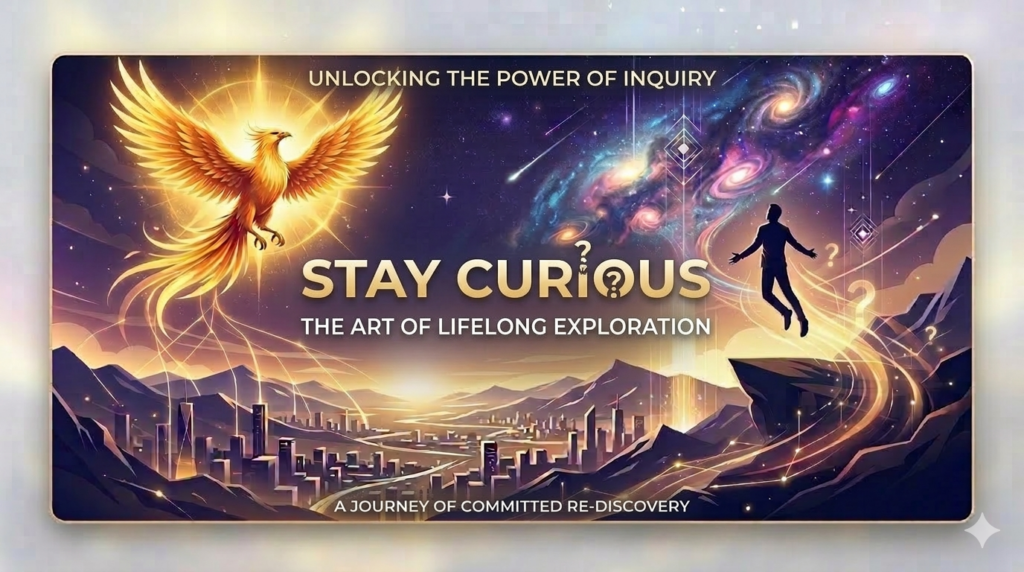
Every child begins life curious.
They ask endless questions.
They explore everything around them.
They see the world as a place full of mystery.
But somewhere along the way, curiosity often fades.
Responsibilities grow.
Routines take over.
Questions become fewer.
The principle Stay Curious reminds us to protect something incredibly powerful:
The desire to keep learning about the world.
Because curiosity is the engine behind discovery, creativity, and progress.
TLDR: The Principle in 30 Seconds
If you remember three ideas from this principle, remember this:
• Curiosity keeps the mind active and expanding.
• Questions often lead to breakthroughs.
• The people who keep learning keep growing.
Curiosity is not just a trait.
It is a mindset that keeps life interesting and full of possibility.
What “Stay Curious” Really Means
Staying curious means continuing to ask questions about the world.
It means refusing to believe that learning has an endpoint.
Many people assume that education ends after school or university.
But the most interesting individuals treat learning as a lifelong process.
They read.
They observe.
They explore ideas outside their comfort zone.
Curiosity allows people to see possibilities others overlook.
And in many cases, the difference between stagnation and growth is simply the willingness to keep asking why.
The Psychology of Curiosity
Curiosity plays a powerful role in human development.
Psychologists describe curiosity as the desire to close gaps in knowledge.
When people encounter something they do not understand, curiosity motivates them to explore until the mystery is resolved.
This process stimulates learning, creativity, and innovation.
Curiosity also activates the brain’s reward system.
Discovering new ideas or insights creates a sense of excitement and satisfaction.
This is why curious people often experience life as more interesting and engaging.
Why Curiosity Fades Over Time
Despite its importance, curiosity often declines as people grow older.
Several forces contribute to this change.
Comfort With Familiarity
Once people develop routines and expertise, they may feel less need to explore new ideas.
Familiarity can slowly replace curiosity.
Fear of Looking Uninformed
Some people avoid asking questions because they worry about appearing uninformed.
But curiosity often requires admitting that you do not know something yet.
Overstimulation
Modern life constantly floods people with information.
Ironically, this can reduce curiosity because attention becomes fragmented.
True curiosity requires focused attention.
Real Examples of Curious Minds
Many influential individuals attribute their achievements to relentless curiosity.
Albert Einstein
Albert Einstein once emphasized the importance of curiosity in discovery.
His willingness to question established assumptions led to revolutionary insights about space, time, and the universe.
Leonardo da Vinci
Leonardo da Vinci explored a vast range of subjects including art, anatomy, engineering, and science.
His curiosity drove him to study everything from human anatomy to flying machines.
Steve Jobs
Steve Jobs often credited curiosity and exploration with shaping Apple’s most innovative products.
His interest in design, technology, and philosophy influenced the development of groundbreaking devices.
Signs You Are Staying Curious
Curious individuals often demonstrate certain behaviors.
They:
• ask thoughtful questions
• explore ideas outside their expertise
• enjoy learning about unfamiliar topics
• remain open to changing their perspectives
Curiosity creates intellectual flexibility.
It allows people to evolve as new information appears.
How to Cultivate Curiosity
Curiosity can be strengthened through intentional habits.
Ask More Questions
Instead of accepting information passively, ask deeper questions about how and why things work.
Explore Different Fields
Learning outside your primary expertise expands perspective and sparks new ideas.
Read Widely
Books expose the mind to new viewpoints, cultures, and discoveries.
Stay Open to Being Wrong
Curiosity thrives when people are willing to update their beliefs as they learn.
Growth requires intellectual humility.
The Hidden Advantage of Curiosity
Curiosity quietly compounds over time.
A curious person accumulates knowledge across many domains.
Eventually this knowledge begins to connect.
Ideas from different fields combine to create insights that others may never notice.
Innovation often emerges from these unexpected connections.
This is why curious individuals frequently become creative thinkers and problem solvers.
The Aura Coded Principle
At Aura Coded, Stay Curious represents the belief that growth never truly ends.
The world is far too complex and fascinating to fully understand in a single lifetime.
But curiosity allows us to keep exploring.
And those who keep exploring often discover opportunities, insights, and ideas that transform both their lives and the world around them.
Because every meaningful discovery begins with a simple question.
Explore More Principles
The Stay Curious mindset becomes even stronger when combined with other principles.
Explore related ideas:
• Believe Big
• Live Fully
• Do The Work
• Rise Again
Together these ideas create a mindset focused on growth, exploration, and meaningful progress.
FAQ
What does “stay curious” mean?
Staying curious means continuing to explore new ideas, ask questions, and learn throughout life.
Why is curiosity important?
Curiosity drives learning, creativity, and discovery. It helps people expand their knowledge and adapt to new opportunities.
How can someone become more curious?
Ask more questions, read widely, explore unfamiliar subjects, and remain open to new perspectives.