
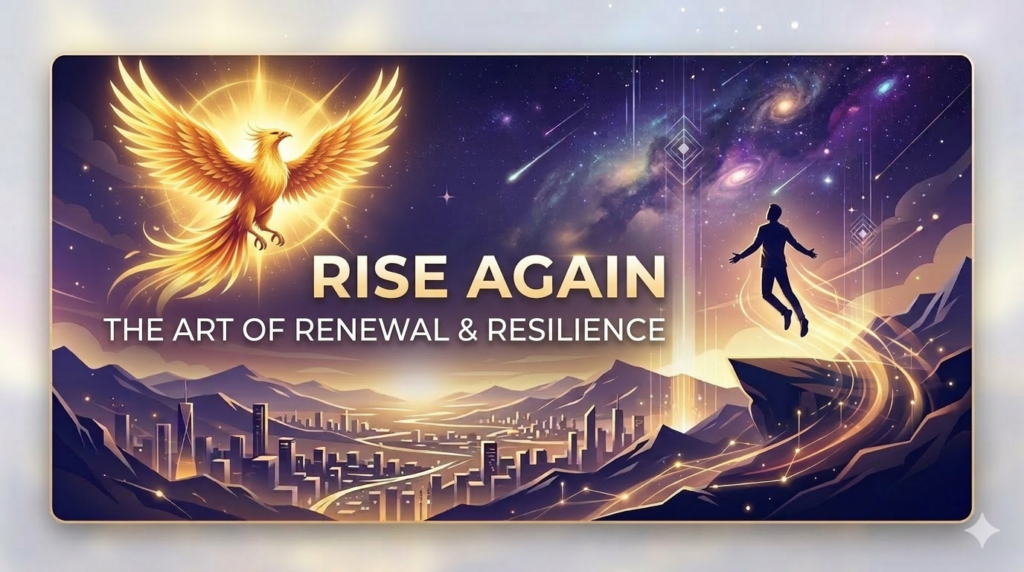
The strength to begin again after everything falls apart.
Everyone celebrates success. Few people talk about what happens before it.
The failed attempts.
The quiet disappointments.
The moments when everything seems to collapse.
At some point, every meaningful journey includes a fall.
Plans break. Confidence weakens. Progress disappears.
The principle Rise Again exists for that exact moment.
Because success is not defined by never falling.
It is defined by the courage to stand up again.
TLDR: The Principle in 30 Seconds
Remember three ideas about this principle:
• Falling is part of every meaningful journey.
• What matters most is the ability to recover.
• Every comeback begins with the decision to rise again.
Resilience transforms failure from an ending into a new beginning.
What “Rise Again” Really Means
Rising again means refusing to let a setback define the rest of your story.
Failure, disappointment, and mistakes are inevitable in any ambitious pursuit. But they only become permanent when people stop trying.
To rise again is to acknowledge the fall without accepting defeat.
It is the willingness to rebuild confidence, restart effort, and continue moving forward.
In many cases, the most important decision someone makes is not the first attempt.
It is the decision to try again after things go wrong.
The Psychology of Resilience
Resilience is the mental ability to recover from difficulty.
Psychologists often describe resilience as a combination of mindset, adaptability, and emotional strength.
Resilient individuals do not avoid setbacks.
Instead, they interpret setbacks differently.
Where others see failure as proof of inability, resilient people see it as part of the learning process.
This shift in perspective allows them to recover faster and continue progressing.
Over time, repeated recovery builds mental strength.
Why Many People Struggle to Rise Again
Getting back up sounds simple, but it can feel incredibly difficult.
Several forces make recovery challenging.
Fear of Repeating Failure
After experiencing a setback, people often hesitate to try again because they fear experiencing the same disappointment.
Loss of Confidence
Failure can temporarily weaken self-belief, making it harder to take action again.
Social Judgment
People sometimes worry about how others will perceive another attempt.
This fear of judgment can prevent individuals from restarting their journey.
Yet history repeatedly shows that many breakthroughs happen only after multiple failures.
Real Examples of People Who Rose Again
Some of the most inspiring success stories involve individuals who recovered after major setbacks.
Michael Jordan
Michael Jordan was famously cut from his high school basketball team.
Instead of accepting defeat, he used that setback as motivation to improve.
His determination eventually led him to become one of the greatest athletes in sports history.
Walt Disney
Walt Disney faced several business failures early in his career.
At one point, a newspaper editor reportedly fired him for “lacking imagination.”
Despite those setbacks, he continued creating and eventually built one of the most influential entertainment companies in the world.
J. K. Rowling
J. K. Rowling experienced numerous rejections before a publisher accepted the manuscript for Harry Potter.
Her persistence transformed rejection into one of the most successful book series ever written.
The Hidden Advantage of Rising Again
People who recover from failure often develop qualities that others never build.
They develop:
• resilience
• patience
• perspective
• emotional strength
These qualities become powerful advantages over time.
Those who rise again frequently become stronger, wiser, and more prepared for future challenges.
How to Rise Again After a Setback
Recovering from failure requires deliberate action.
Accept the Fall Without Defining Yourself by It
Failure is an event, not an identity.
Separate the experience from your sense of self.
Learn From the Experience
Every setback contains information.
Understanding what went wrong transforms failure into a valuable lesson.
Start Small
Rebuilding momentum often begins with small steps.
Progress restores confidence.
Remember Your Original Purpose
Reconnecting with the reason you started can reignite motivation.
Purpose helps people move forward even after difficult setbacks.
The Power of Comebacks
Some of the most powerful stories in history are comeback stories.
People admire individuals who recover from adversity because it reflects something deeply human.
Everyone falls.
But not everyone rises again.
The people who do often discover that their greatest strength was never avoiding failure.
It was the ability to keep going after it.
The Aura Coded Principle
At Aura Coded, Rise Again represents the belief that failure is not the opposite of success.
It is part of the path to it.
The individuals who ultimately succeed are rarely the ones who never fail.
They are the ones who refuse to remain on the ground.
Because sometimes the most important victory is simply standing up one more time.
Explore More Principles
The Rise Again mindset becomes even stronger when combined with other principles.
Explore related ideas:
• Keep Going
• Believe Big
• Know Your Worth
• Stay Humble Stay Hungry
Together these principles create the mindset architecture for resilience and growth.
FAQs
What does “rise again” mean?
It means recovering from setbacks or failure and continuing forward despite challenges.
Why is resilience important for success?
Resilience allows people to learn from mistakes, adapt, and continue pursuing their goals even after difficulties.
How do you rise again after failure?
Accept the setback, learn from it, rebuild confidence with small steps, and continue moving forward.